Tamil Nadu · MSME Consulting
Tamil Nadu’s best businesses are held back by execution, not ambition.
Simpleworks Consulting works with founder-led manufacturing and export businesses across Chennai-Sriperumbudur, Hosur-Krishnagiri, Salem, Tiruppur, and Coimbatore — on strategy, go-to-market, execution, and the decisions only a founder can make.
Sound familiar?
The business grew on relationships. Now it’s stuck on them.
Most MSMEs in Tamil Nadu’s clusters got to where they are on the strength of one founder, a handful of relationships, and a lot of hard work. The problems start when that’s no longer enough.
One or two customers account for most of your order book — and you know exactly how exposed that makes you.
Every decision still routes through you. Nothing moves when you're travelling.
You've set targets for the year, but nobody could tell you what they're accountable for this quarter.
Sales happens through your personal relationships. There's no process behind it.
The next generation is in the business, but nobody has said out loud who decides what.
You've been meaning to fix all of this for two years. Something urgent always comes first.
None of this is a strategy problem. It’s an execution problem — and it doesn’t get solved by a report. It gets solved by someone working alongside you, quarter after quarter, until the business runs differently.
What we do
Four things. Done properly.
Simpleworks Consulting is not a broad-scope strategy firm. We do four things for founder-led businesses in the ₹10–100 crore range — and we do them as hands-on execution work, not advice you’re left to implement alone.
Business strategy
Where the business should be going, and what it has to stop doing to get there.
- Clarifying which segments, products, and customers actually make money
- Deciding between focus and diversification — with the numbers behind it
- Building a three-year direction the business can actually resource
- Making the hard calls on what to exit, not just what to add
Go-to-market
Reducing your dependency on the customers you already have, and building a way to win the ones you don't.
- Quantifying customer concentration risk and what it's costing you
- Identifying the next realistic 2–3 accounts or verticals — not a wish list
- Building a sales process the business can run without you chasing every lead
- Pricing and margin discipline, especially in job-work and sub-contract models
Execution efficiency
Turning “grow 20% this year” into something your team can act on next Monday — and be measured against next quarter.
- OKRs tied to the priorities that actually move the business
- Accountability distributed across the team, not held in the founder's head
- A review cadence that survives past the first quarter
- Removing the operational friction that quietly eats capacity
MSME coaching — founders & family business
The problems that aren't on any spreadsheet: who decides what, and what happens when you're not in the room.
- Delegation and decision-making — getting out of the operational weeds
- Succession planning and role clarity across generations
- Structuring conversations the family has been avoiding
- A regular outside perspective, from someone with no stake in the internal politics
How we start
A discovery call first. Then a defined scope.
We don’t quote before we understand the problem. A discovery call establishes what’s actually going on; from there we scope the work. An engagement typically runs across a quarter, with a review quarter to follow — long enough to solve the problem and set the motion that keeps delivering after we step back.
Discovery call
One call. No deck, no pitch — we work out what's actually going on and whether there's a fit.
Scoping
We define the specific problem to solve, the deliverables, and the remote/on-site mix — before any retainer starts.
Execution quarter
Working sessions through the quarter, building the process and the accountability into your team as we go.
Review quarter
We review what's held, correct what hasn't, and hand over — so the motion runs without us.
What changes
What you should expect to be different
You know your concentration risk — and you're acting on it.
A named list of target accounts or segments, with someone owning each one, instead of a worry you've been carrying.
The quarter has owners, not just targets.
Written objectives, assigned to people, reviewed on a fixed date. You stop being the only person tracking progress.
The business runs without the consultant.
The point isn't a dependency — it's that the process, the cadence, and the accountability stay in place after we've stepped back.
Who you’d be working with
39 years on the operating side, not the slide-deck side
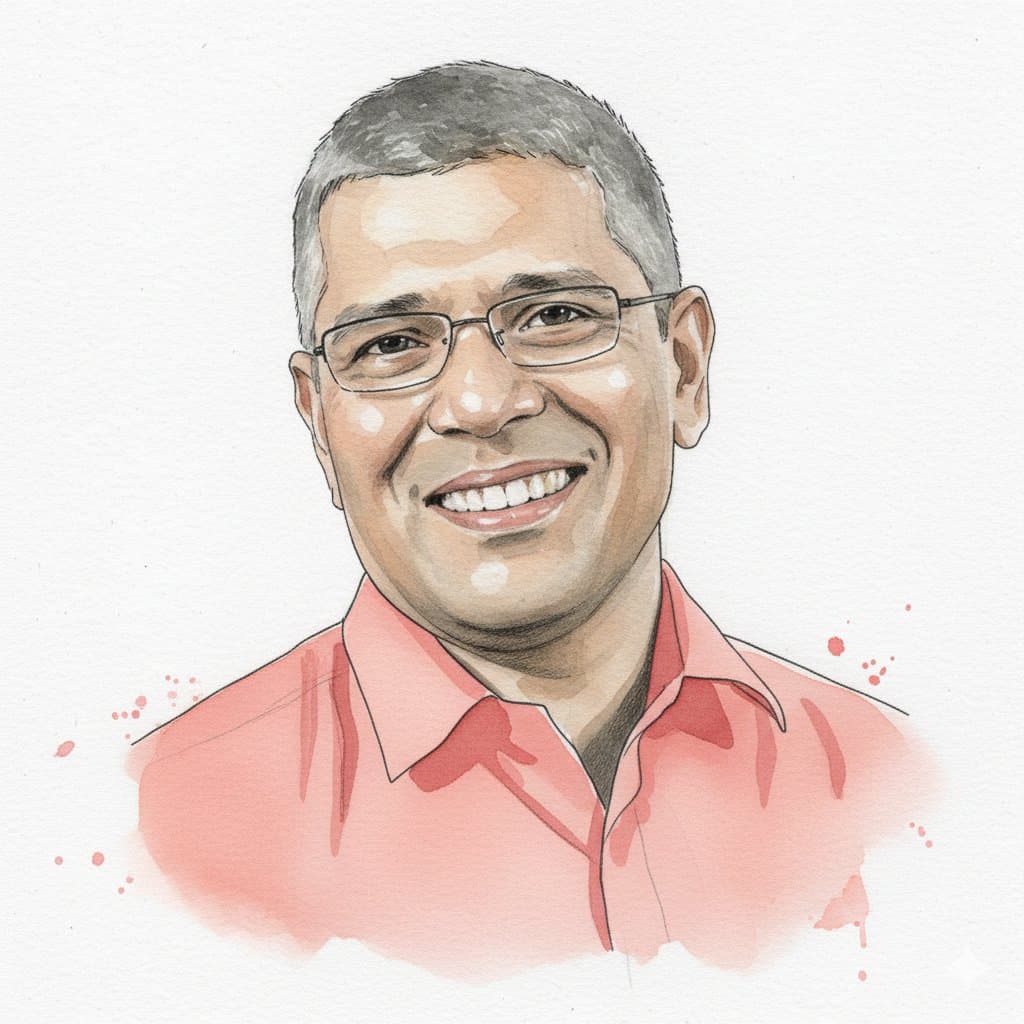
Simpleworks Consulting is Premraj Menon. Not a team of analysts — the person you speak to on the first call is the person who does the work.
He spent 39 years in sales, distribution, and P&L leadership before starting this practice: MRF and Apollo Tyres, both built on the same Tamil Nadu manufacturing economy your business operates in; direct sales leadership at Bharti Airtel; and Chief Operating Officer of the Kerala Circle at Tata Docomo, running a full circle P&L. He then built and ran two businesses of his own as an entrepreneur — with all the operating risk that carries.
That matters for a specific reason. When a Hosur machine-shop owner describes losing leverage with an OEM, or a Salem foundry founder talks around a succession problem, it isn’t a case study — it’s a conversation he’s been on the other side of.
Where we work
Five clusters. Five different problems.
We don’t run one playbook across Tamil Nadu. The problem holding back a Hosur component supplier looks nothing like the one in a Salem foundry, or the one in Tiruppur.
AUTO & ELECTRONICS
Chennai · Sriperumbudur · Oragadam
Tier-1 and Tier-2 auto component suppliers, EMS and electronics contract manufacturers, and ancillary units feeding Chennai's OEM belt — many out of the SIPCOT estates at Sriperumbudur and Oragadam.
The problem: orders aren't scarce, leverage is. Price pressure from procurement, stretched payment cycles, and no clear read on how the OEM actually ranks you against the next supplier.
PRECISION ENGINEERING
Hosur · Krishnagiri
Machining, forging, and precision component units serving Bengaluru and Chennai OEMs from the Hosur-Krishnagiri corridor, anchored by the SIPCOT Hosur estates.
The problem: one anchor customer carries most of the order book. Everyone knows it's a risk; nobody has a worked-out plan for winning the second one.
TEXTILES, STEEL & FOUNDRIES
Salem
Textile processing, steel re-rolling, and foundry units around Salem Steel and the local re-rolling mills — largely multi-generational family businesses.
The problem: The next generation is in the business but the decisions still aren't. Roles are assumed rather than agreed, and the succession conversation keeps getting postponed.
KNITWEAR & EXPORT APPAREL
Tiruppur
India's knitwear and hosiery export hub, built around the TEA network — job-work heavy, buyer-driven, and highly seasonal.
The problem: turnover is known; per-buyer margin after a full season of price pressure and rejections isn't. Commercial discipline lags behind the relationship.
ENGINEERING & MACHINERY
Coimbatore
Pump and motor manufacturers, textile machinery, foundries, and machine tools — with CODISSIA as the sector's collective voice.
The problem: The product range grew by accretion, not decision. Too many SKUs, unclear which ones earn their place, and no agreed basis for choosing.
Vellore-Ranipet-Ambur (leather) and Karur (home textiles) — get in touch if that’s you; we’re actively looking at both.
Different problems. The same four disciplines.
We don’t claim sector expertise in five industries. What these businesses have in common is that the problem is rarely technical — it’s commercial and organisational. That’s what we work on.
Business strategy
Which customers, products, and segments actually make money — and what the business should stop doing.
Go-to-market
Reducing dependency on the customers you have, and building a repeatable way to win the ones you don't.
Execution efficiency
Turning intent into quarterly objectives your team owns and gets reviewed against.
MSME coaching
The founder and family questions: delegation, decision rights, and succession.
Prem spent 39 years on the operating side, including at MRF and Apollo Tyres — the kind of large buyer many of these businesses sell into. Knowing how the other side of that table evaluates a supplier is often where the useful conversation starts.
Engagement model
Mostly remote. On-site when it matters.
Tamil Nadu engagements run on a hybrid model — a structured remote retainer for the ongoing work (reviews, go-to-market planning, coaching sessions), with in-person visits to your facility at the points that need it: kickoff, quarterly reviews, or a problem that’s easier to solve on the shop floor than over video.
The mix is agreed upfront as part of the engagement plan — so you know exactly what you’re getting before the first invoice, not after it.
From the blog
Related reading
When One OEM Is 60% of Your Revenue: Customer Concentration Risk in Hosur's Auto Component Belt
Customer concentration risk damages an auto component business long before the anchor OEM leaves, by removing its ability to price independently. For founders in the Hosur-Krishnagiri belt, the real exposure is measured in months of survival, not percentage of revenue.
Read article →Business Strategy Consulting for Indian MSMEs: How the Simpleworks Consulting 4P Framework Turns Problems Into Plans
Most MSME founders arrive with a presenting problem. The Simpleworks Consulting 4P Framework is built on one uncomfortable truth: that problem is almost never the real one — and a strategy without execution is just a document.
Read article →The Go-to-Market Strategy Most Indian MSMEs Skip — And Why It’s Costing Them
Most Indian MSMEs don't fail at building products — they fail at go-to-market because they jump straight to channel strategy before deciding who, precisely, they're selling to. That one skipped step is why sales efforts plateau, win rates stay low, and founders blame the wrong things.
Read article →Is Your Family Business Ready for the Next Generation? 5 Hard Questions Every Owner Must Answer
80% of Indian family businesses don't survive to the second generation. The reason isn't an unprepared next generation — it's an unprepared business.
Read article →A new piece for this cluster is on its way.
A new piece for this cluster is on its way.
Before you get in touch
Frequently asked
You're based in Bengaluru. How does that work for a business in Salem or Tiruppur?
Most of the work is remote by design — structured calls, reviews, and planning done over video and shared documents. On-site visits are built into the engagement plan for kickoff, quarterly reviews, and anything better solved on the shop floor. The split is agreed before we start.
What size of business do you work with?
Founder-led businesses roughly in the ₹10–100 crore revenue range. Below that, the problems are usually different; above it, you likely need a larger firm than this one.
What's Prem's background with Tamil Nadu businesses specifically?
39 years in sales, distribution, and P&L leadership — including MRF and Apollo Tyres, both rooted in Tamil Nadu's manufacturing economy — plus Bharti Airtel and a full circle P&L as COO at Tata Docomo. He has also built and run two of his own businesses.
Do you work with family businesses?
Yes — they're a core part of the practice, particularly around succession, role clarity, and formalising decisions that currently sit with one person.
What does an engagement cost?
It depends on the scope, which we define after the discovery call — not before. The discovery call itself is free, and you'll have a defined scope and a number before you commit to anything.
How long does an engagement run?
Typically a quarter of execution work, followed by a review quarter. Scope is defined after the discovery call, not before it. Execution work doesn't show results in four weeks, and we'd rather set that expectation upfront.
Next step
One conversation. Then you’ll know whether this is worth your time.
No deck, no proposal, no obligation. Tell us where the business is stuck and we’ll tell you honestly whether we’re the right people to help — and if we’re not, who might be.
Call on 90360 99000 or write at pm@simpleworks.in