Scaling a Business: Why 0-to-1 Rules Break at 10-to-100
The rules that take a business from zero to one stop working between ₹10 crore and ₹100 crore because each one depends on the founder being in the room. Founders who check the market and their own business first, then sort every old rule into keep, convert or retire, can scale without becoming the bottleneck.
The founder at ₹10 crore is usually the busiest person in the company. Revenue has grown, the team has doubled, and growth has still flattened. The instincts that built the business (move fast, decide alone, close the big deals yourself) are now what holds it in place.
This is the hard part of scaling a business. The rules that take you from zero to one are not wrong. They fail because each one quietly depends on the founder being in the room. Going from ₹10 crore to ₹100 crore means replacing that dependence with design, and before you change any rule, you need to check what is happening outside the business and inside it.
0-to-1 vs 10-to-100: two different problems
Zero to one is a search problem. You are looking for something that works: a customer who will pay, a product they will buy again, a price that leaves a margin. Speed matters because every week of searching costs money, and the founder stays close to everything because the learning is in the details.
Ten to a hundred is a repetition problem. You know what works. The question is whether it can happen again, at ten times the volume, without you in the middle. Founders who treat the second as a bigger version of the first tend to stall.
I lived both phases in my previous organisation, a telecom business that I joined in its start-up phase, as one of the first people recruited into sales and distribution. We built distribution, people and processes from ground zero, working through the four Ps of marketing: product, price, place and promotion. The mindset was singular: a great launch, and the first 10 lakh customers in the shortest possible time.
By the time we passed 20 lakh customers, the job had changed. The question was no longer how fast we could win customers. It was whether the sales system worked as a system, with or without any one of us. For the first three months after acquisition, the sales and distribution team handled each new customer, the first-quarter handholding. After three months, the customer was handed over to the customer success team. Same business, two different ways of thinking.
That pattern is not limited to telecom, and it is the one I now work through with founders at Simpleworks Consulting.
Why founder-led growth runs on borrowed time
In 1972, Harvard Business Review published Larry Greiner's "Evolution and Revolution as Organizations Grow", a model of growth in phases, each ending in a crisis. HBR republished it in 1998 with an update. His sharper point is that every phase grows out of the one before it and sets up the one after. The way you manage to get through one stage is what creates the crisis in the next.
Greiner's first phase is growth through creativity, and it ends in a crisis of leadership. The founder is pulled into running the place day to day, and the business needs direction that instinct alone cannot give. That is the ₹10 crore founder. The fast, hands-on habits are not mistakes. They are a loan taken against the founder's own time and presence.
At small scale, nobody sees the interest. At ₹10 crore it shows up as a founder who approves every purchase, takes every escalated call and holds every key relationship, and a team that has learned to wait. In my previous organisation, I would not have wanted the launch-phase improvisation running a base of 20 lakh customers. The skill is knowing which phase you are in.
Scale-up strategy starts outside: environment, opening and threats
Founders at this stage tend to look inward first, at the team and the numbers. Look outward first. A scale-up strategy built on a misread market only scales the mistake faster.
The business environment. Is your segment growing, flat or shrinking? What is changing in customer behaviour, input costs, regulation, competition and the availability of capital? Two firms with identical execution can end up in very different places because one sits in an expanding segment and the other does not.
The future opportunity. Which adjacent segment, geography, channel or product could double the business? Then ask the harder question: which of them could you serve better than anyone else? Write that answer first.
The challenges ahead. Who gets stronger as you grow: a funded competitor, a large customer gaining pricing power, a shortage of talent? What breaks if your biggest customer or supplier walks away?
These three checks lead to one decision: what to refuse. Michael Porter wrote in "What Is Strategy?" (HBR, 1996) that the essence of strategy is choosing what not to do. At 0-to-1, saying yes to every customer is how you find your market. At ten times the size, the same habit scatters you across segments, cities and products you cannot serve well.
Then inspect the inside: people, process, finance and go-to-market strategy
When you are scaling a business, test four areas inside it. For each one, answer the questions honestly and notice which 0-to-1 rule is giving way.
People
- How many decisions still need you each week?
- Could your second layer run the business for a month without you?
- Who is the single point of failure?
The rule that breaks is "hire people who think like me". Early hires extend you. The next layer has to replace parts of you, which takes managers, clear decision rights and measures such as OKRs (objectives and key results), not proximity. Greiner's later phases show the opposite risk. Delegate without coordination and managers start running their own patch their own way, while the centre loses its grip.
Process
- What is written down, and what lives in someone's head?
- Which errors repeat?
- Where does work wait?
The rule that breaks is "we'll fix it when it breaks". With the founder in the room, fixing is quick. Without them, the same fault returns every month because nobody owns the cause. The first-quarter handholding by sales and distribution, followed by the handover to customer success after three months, was a process: a defined path that did not depend on who happened to be on duty.
Finance
- What is your margin by product and by customer?
- How long does cash take to come back after you spend it?
- How much working capital does the next ₹10 crore of growth need?
- How concentrated is your revenue?
The rule that breaks is "if sales are up, we're fine". Growth consumes cash. You buy material and pay people before customers pay you, so a profitable business can still run short while growing fast. Asian Paints is the example I keep coming back to. An Outlook Business piece on the company argued that in paints, how well you run supply and manage working capital decides who wins, and noted that Asian Paints was forecasting demand on mainframes as far back as the 1970s. It treated cash and supply as systems to be built, not habits to be kept.
Go-to-market strategy
- What share of revenue do you sell personally?
- Is there a defined customer, a standard pitch and a visible pipeline?
- What does it cost to win a customer, and how long does it take to earn it back?
The rule that breaks is "I'll close the big ones myself". Paul Graham's 2013 essay "Do Things That Don't Scale" is the best defence of founder-led selling. When someone agreed to use Stripe, the Collison brothers set it up for them on the spot instead of sending a link. But the principle is about sequence, not a case against ever scaling: do it by hand to learn, then build the system. The mistake at ₹10 crore is often stopping after the first half. In my previous organisation, the second half was making the sales system operate as a system, so results did not depend on any individual.
What to keep, convert and retire between ₹10 Cr and ₹100 Cr
The practical answer to scaling a business is to sort every 0-to-1 rule into one of three buckets.
Keep the rules about the customer: staying close to them, being honest about what you can deliver, acting quickly when something goes wrong. These do not expire, but they need a route that does not pass through you, such as a standing monthly review of customer feedback.
Convert the rules that run on memory. Your pricing instinct becomes a pricing policy with discount limits. Your pitch becomes a standard pitch and a handover. Your personal follow-up becomes a routine, like the first-quarter handholding we built in my previous organisation.
Retire the rules that send everything through you: approval for every purchase, being the only escalation point, hiring in your own image.
Then do it in order. In my 4D approach at Simpleworks, quarter one is Discover and Diagnose: run the external and internal checks with real numbers. Quarter two is Decide: choose what to refuse, assign decision rights, set three to five OKRs. Quarters three and four are Execute: convert one founder-dependent process at a time and review monthly.
Pace matters. At TechHR India 2026, Haldiram's Executive Director Ashok Tyagi challenged the assumption that a family-run company must immediately recreate the full hierarchy of a large multinational. Haldiram used training, repeated communication, pilots and time-bound adoption before bringing in incentives and consequences. Professionalise no faster than the business can absorb.
The strongest objection: "Founder mode" works better
The best argument against all this comes from Paul Graham's September 2024 essay "Founder Mode". It describes a talk by Airbnb's Brian Chesky, who was advised, as the company grew, to "hire good people and give them room to do their jobs." He followed this advice and the results were disastrous. Chesky has since said he still manages Airbnb like a startup, involved in personnel decisions for around 50 employees. The objection is serious: build the layers, hand over the controls, and you may lose the speed and judgement that made the company worth scaling. Greiner's fourth crisis, red tape, makes the same point from the other side.
I think the objection is right about the risk and wrong about the remedy. Chesky's version is not a founder doing everything. It is a founder choosing a narrow place to stay involved, on purpose. That is design. The thesis here is not "hire managers and step back". It is "decide which rules still need you, and build systems for the rest". In my previous organisation, the three-month handholding and the handover to customer success were there so that customers were looked after properly whoever handled them, not to slow anyone down.
The thesis does have limits. If you cannot yet repeat what works, you are still at 0-to-1, and building systems now is premature. And some founders rightly choose to stay at a size they can hold in their head.
What the founder is really building now
At 0-to-1, the founder builds a product. At 10-to-100, the founder builds the thing that builds the product: a business that works without needing them in the room. Scaling a business is a long, deliberate exercise in becoming less necessary.
Take one page and list every rule you run on today. Mark each one keep, convert or retire. Then ask the question that matters: which of these would still work if you took a month off? The ones that would not are your next year's work.
I would back the founder who starts designing their own absence over the founder who simply works harder at ₹10 crore. There are more ideas like this on the Simpleworks blog.
About Prem Menon
Prem Menon is the founder of Simpleworks Consulting, working with MSME founders and growth-stage businesses across India to turn strategy into execution. With experience spanning manufacturing, SaaS, retail, and professional services, Prem brings a practitioner's eye to the problems most consultants only theorise about.
Ready to check your business before you change the rules?**
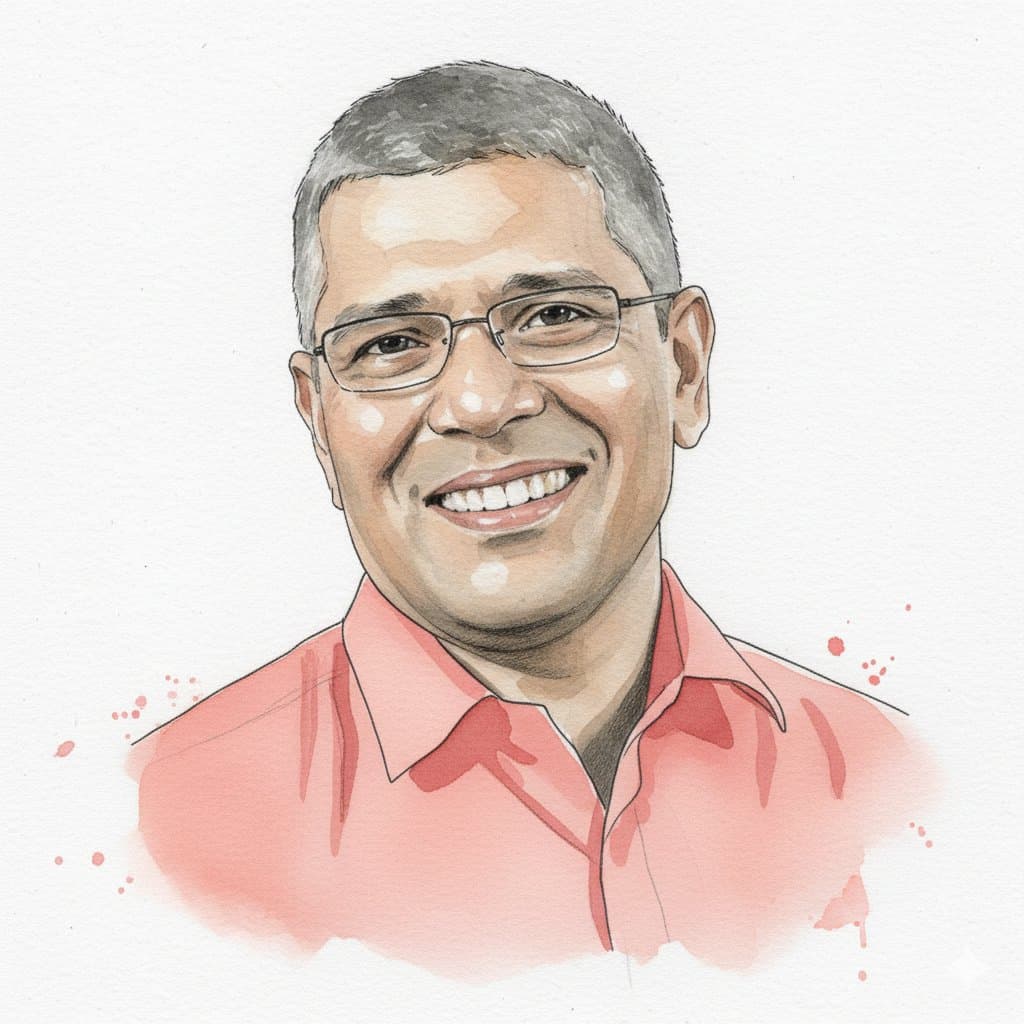
Premraj Menon
Founder, Simpleworks Consulting. 39 years across Telecom, Automotive and Consumer Durables — now helping Indian MSME and family-business founders grow with clarity.