Why Family MSMEs Must Separate Ownership from Management to Scale
The post argues that family MSMEs stall because the founder holds two jobs — owner and manager — that run on opposing clocks, and the ownership job always loses. Separating the two is what makes capital discipline, a real second line, and an orderly succession possible.
It's 9:15 on a Tuesday night. The promoter of a ₹40-crore auto-components business is on his phone, approving a purchase order for ₹6,000 worth of packing material. He has been in the plant since seven that morning. Somewhere in a drawer there is a two-year-old note about entering the EV supply chain, which he has not opened since the day he wrote it.
He isn't lazy or disorganised. He is doing two jobs at once, and in most family businesses ownership and management are so tangled that nobody notices one job is quietly eating the other. He stalls not because he lacks ability, but because the owner's work — deciding what the business is for — has no deadline, and the manager's work does. The urgent wins every single day.
Two jobs, two clocks
Strip away the sentiment and there are only two distinct jobs in any company.
Ownership is the job of deciding what the business exists to do. Where capital goes. How much risk is acceptable. Which markets to enter and which to abandon. Who runs the company after you. What the family takes out and what it leaves in. These decisions get made a handful of times a year, and each one compounds for a decade.
Management is the job of making this quarter happen. Targets, hiring, collections, delivery, the customer who is threatening to leave. These decisions get made forty times a day, and each one expires in about a week.
The two run on different clocks. That is the whole problem. In a promoter-led MSME the same person holds both, and because ownership decisions carry no due date, they are perpetually deferred to a quieter week that never arrives. The business ends up well managed and completely undirected.
India's larger business families worked this out long ago. Tata separates the ownership entity from the operating companies. The Murugappa group runs a family council distinct from the boards that manage its businesses. Godrej spent years formalising who decides what before the family split its holdings. None of these structures made the families less involved. They made involvement deliberate rather than reflexive. What almost no MSME has is the modest version of the same thing: a single page saying which decisions belong to the owner and which belong to whoever runs the place.
Why family-run MSME governance collapses into firefighting
Ask a founder what he did last week and you'll get a list of rescues. A dispatch that nearly missed, a supervisor who quit, a bank manager who needed a document. Ask him what he decided about the next three years and the answer thins out.
This isn't a discipline failure. It's a structural one. Firefighting is legible, immediate, and rewarding. You can see the fire go out. Ownership work is abstract, slow, and offers no feedback for years. Put both on one person's desk and the outcome is settled before the week begins.
Think of a pilot who keeps leaving the cockpit to serve drinks in the cabin. The passengers are delighted. Service has never been better. The plane is still flying wherever it was pointed an hour ago.
Three things break when this goes on long enough.
Capital gets allocated by accident. Money follows whichever part of the business shouted loudest this quarter. A second machine gets bought because the plant head asked persistently, not because anyone compared it against opening a new region. Over five years these small unexamined choices are the strategy, and it is an unmanaged one.
No second line forms. A founder in the middle of every decision trains his managers to bring him decisions. They get good at escalating and never get good at deciding. Then the founder concludes, accurately, that his team can't handle responsibility, and takes back more. The loop tightens each year.
The business becomes unsellable and unlendable. Private equity, strategic buyers, even serious lenders apply the same test: what happens to this company if the promoter stops coming in? When ownership and management sit in one head, the honest answer is it stops. That discount is real, and it is paid at exactly the moment the family most needs the value: a succession, a health event, a buyout of a sibling.
Professionalising a family business starts with a boundary, not a hire
Here is the most common and most expensive mistake I see. The founder recognises he is overloaded and hires a CEO or COO.
Fourteen months later, the professional has left. The founder concludes that outsiders don't understand family businesses. The organisation concludes that the founder was never serious. Both are half right, and both are looking at the wrong thing.
The hire failed because nobody wrote down what the founder had stopped deciding. Without that, the new CEO holds a title and no authority, while the organisation quietly keeps routing every real question back to the person whose surname is on the building. You cannot delegate a role that has never been defined. You can only add a salary to it.
The boundary comes first. Before any hire, sit down and split the decisions themselves. Not roles, not org charts. Decisions.
Owner keeps: capital above a stated threshold, entering or exiting a business line, debt and dilution, the top two or three appointments, family employment terms, the dividend-versus-reinvestment call, succession.
Management holds: pricing within a band, hiring below the top layer, vendor selection, production planning, marketing spend, day-to-day customer negotiation, everything with a horizon shorter than a year.
Then apply a test to anything you're unsure about. Ask: would I still make this decision if I owned the shares but had no desk in this building? If yes, it's an ownership decision. Keep it, and give it a calendar slot the way you'd give a customer meeting one. If no, it belongs to management, and every time you take it back you are teaching your team that the boundary is decorative.
This is unglamorous work. It's also the point at which most attempts at professionalising a family business either become real or become theatre. In our work with MSME founders at Simpleworks Consulting, the decision-rights list is almost always the artefact that was missing, not the strategy deck, which usually already exists in a drawer.
Two practical notes. The boundary must be written and shared, or the organisation will keep testing it. And the founder has to lose an argument publicly at least once, approving a decision he'd have made differently, before anyone believes the new structure is more than a document.
Family business succession planning in India rests on this separation
Most Indian succession conversations start in the wrong place. They start with who. Which son, which daughter, which nephew. That question is unanswerable while family business ownership and management remain fused, because you're asking one person to inherit two jobs that require opposite temperaments.
Separate them and succession stops being a single traumatic handover and becomes two independent transfers that can happen at different times, at different speeds, to different people.
Shares can move gradually, through a structure, with tax and family fairness worked out calmly.
The chair can move to whoever is actually best at running the company. That may be the next generation, may be a professional, and may be one of each at different points. A daughter who wants to be an owner-director and not a plant manager becomes a legitimate outcome rather than a family disappointment.
This reframing also solves the next-gen entry problem. Today the returning son or daughter usually enters in a fog: nominally a manager, actually an owner, taken seriously by no one and accountable to nothing. Decide the entry. If they come in as management, they get a real role, a real boss, and a real review, even if the boss reports to their father. If they come in as owners, they sit on the board, learn capital allocation, and stay out of the operating line. What kills the next generation's credibility isn't inexperience. It's ambiguity. I've written more about that pattern in the Simpleworks Consulting blog on family business succession.
The strongest objection: founder involvement is the edge
Now the serious counter-argument, and it deserves a straight answer.
Founder involvement is not a bug. It's often the reason the business exists. The promoter answers a customer's call at 10pm and wins the account. He knows the cost of every input to the second decimal and prices better than any professional could. He walks the shop floor and spots the problem three weeks before a report would. Layer in a professional structure and you get committees, slower decisions, higher fixed costs, and a management team optimising for the review rather than the customer. Many MSMEs have professionalised themselves straight into mediocrity.
All of that is true. And it doesn't rescue the fused model. It sets the conditions for when separation makes sense.
Below a certain scale, separation is premature. If the business is under roughly ₹20–25 crore in revenue, or has no manager who could hold a P&L, adding a governance layer buys cost and loses speed. At that size the founder should be in everything. Fusion is a feature of the early business, not a permanent flaw.
The thesis holds at the point where the founder becomes the constraint rather than the accelerator. That is usually visible as a business growing 8–10% a year for three years while the founder works harder each year. Past that point, the founder's judgment doesn't become less valuable. It becomes too valuable to spend on ₹6,000 purchase orders. Separation isn't the removal of that judgment. It's the decision to apply it where it compounds. Turning that intent into working practice is the gap between strategy and execution most MSMEs never cross.
The question underneath the structure
There's an uncomfortable thing to notice at the end of all this. Most founders who resist separating ownership from management resist it because they're better at one job than the other, and it isn't the one their shareholding implies.
They are excellent managers who happen to own the equity. Running the place is where they're competent, respected, and needed. Ownership work — sitting with an ambiguous ten-year question and no one to escalate it to — is lonelier and offers no daily proof that you're any good at it. Staying in operations isn't a time-management failure. It's a preference, and usually an unexamined one.
So the useful question isn't "should I professionalise." It's this: of the two jobs you currently hold, which one would you keep if you could only keep one, and does the business have anyone else who could do the other?
Answer that honestly and the structure mostly designs itself. Avoid it, and you'll spend another decade doing both jobs at half strength, calling it commitment.
About Premraj Menon
Premraj Menon is the founder of Simpleworks Consulting, working with MSME founders and growth-stage businesses across India to turn strategy into execution. With experience spanning manufacturing, SaaS, retail, and professional services, Premraj brings a practitioner's eye to the problems most consultants only theorise about.
Ready to separate the owner's job from the manager's job?
[Let's have a quick introductory call with Premraj Menon →](https://simpleworks.in/contact
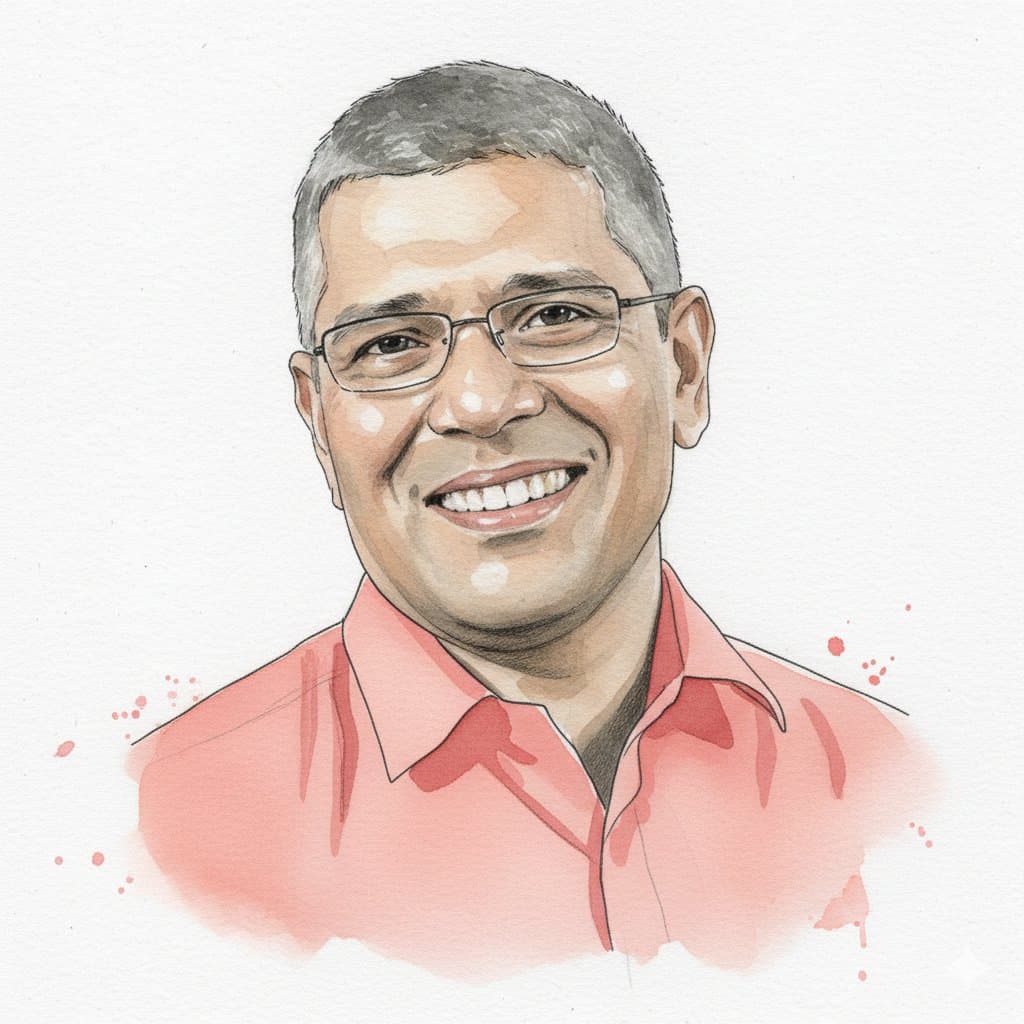
Premraj Menon
Founder, Simpleworks Consulting. 39 years across Telecom, Automotive and Consumer Durables — now helping Indian MSME and family-business founders grow with clarity.