How Indian MSMEs Can Break Through the 10-Year Revenue Ceiling
Learn how to scale MSME business in India past the 10-year revenue ceiling with three shifts in strategy, capital allocation and leadership structure.
The most dangerous number in Indian business is not zero. It is ₹40 crore.
Not that figure precisely — for some it is ₹8 crore, for others ₹120 crore. But every seasoned founder recognises the shape of it. The business grew for eight or ten years. Then it stopped. Revenue now oscillates in a narrow band, year after year, while effort goes up and margin goes down. The question of how to scale MSME business in India is almost always asked from inside this band, by someone who has already proved they can build something.
Here is the argument of this piece: the ceiling is not a market problem. It is an architecture problem. Your business has hit the maximum revenue that one person’s attention can coordinate — and no amount of extra effort from that person will move it.
The Plateau Is Structural, Not Circumstantial
Look at the national picture and the plateau stops looking like your personal failure.
As of February 2026, over 7.86 crore enterprises are registered on India’s Udyam portal. Yet the composition has barely shifted for decades: roughly 98% are micro, under 2% are small, and medium enterprises account for a fraction of a percent. India has an abundance of firms that start and a scarcity of firms that grow. Economists call this the missing middle — the empty space where a country’s mid-sized companies should be.
Note what this rules out. If the plateau were caused by weak demand, poor products, or bad luck, we would expect the distribution to look random. It doesn’t. It looks like a wall placed at a consistent point in a company’s life. Tens of thousands of unrelated businesses, in unrelated sectors, stall at structurally similar moments.
What actually happens is this. In years one to ten, the founder is the system. Pricing, hiring, quality escalation, the important client relationships, the decision on whether to take that order at a thin margin — all of it runs through one head. This is not a flaw; it is why the business survived. Founder attention is the fastest, cheapest coordination mechanism a small company can have.
But attention is finite and non-scalable. Around the point where the business needs more decisions per week than one person can make well, growth stops — not with a crash, but with a slow thickening. Everything takes longer. Good people leave because they cannot get answers. The founder works harder and the number stays flat.
The ceiling is the founder’s calendar, expressed in rupees.
Why Capital Allocation, Not Capital Access, Is the Real Constraint
Ask a stalled MSME founder what he needs and the answer is usually funding. This is half right, and the wrong half.
Credit access is a genuine problem, particularly at the graduation point — a firm becomes too large for microfinance and too small for institutional lending or equity. That squeeze is real and well documented. But it does not explain the businesses sitting on healthy cash flow that still cannot grow. And there are many.
The deeper issue is allocation: where the money that already exists inside the business gets pointed. Most plateaued MSMEs allocate almost all surplus to the same three places — more inventory, more receivables, and the founder’s personal balance sheet. All three feel prudent. None of them buys capacity to grow.
Consider what breaking through actually costs. A second sales leader who can close without you. A finance person senior enough to tell you your gross margin by product line, not just your bank balance. A quality system that holds when you are travelling. These are not cheap, and critically, they produce nothing in month one. They are investments with a twelve-to-eighteen month payback in a business trained by survival to think in ninety-day cycles.
An analogy worth holding: a plateaued MSME behaves like a factory running at 100% utilisation with zero maintenance downtime. It looks maximally efficient and is in fact maximally fragile, because there is no slack in which to build anything new. Growth requires deliberate under-utilisation of the founder. That is the single most counterintuitive move on the list — and it is the one that works.
The practical version of this at Simpleworks Consulting is blunt: ring-fence 8–12% of revenue as a growth allocation, decided annually, spent on capability rather than capacity. Not because the number is magic, but because an explicit budget forces the trade-off into daylight instead of leaving it to be silently lost to working capital.
The Leadership Structure Shift Most MSME Founders Delay Too Long
The final shift is the hardest, because it is emotional before it is operational.
Somewhere near the ceiling, the founder’s role must change from decision-maker to decision-designer. Not delegation in the usual sense — handing out tasks while keeping judgement — but genuinely transferring categories of decision, along with the information and authority to make them well.
Most founders attempt this and retreat within a quarter. The pattern is predictable. They hire a senior person, keep every real decision, watch that person underperform in an impossible role, and conclude that good talent is unavailable in their city. The talent was fine. The structure was not.
Three things make the transfer stick, and all three are unglamorous. First, decision rights written down — a one-page list of what the second line decides alone, what they decide and inform you about, and what genuinely needs you. Second, a management rhythm: one weekly operating meeting with the same numbers, in the same format, every week without exception. Third, tolerance for a worse decision made by someone else over a better decision made by you — for about two quarters, because that is how judgement transfers.
Notice this costs almost nothing. It is not a software purchase or a consulting programme. It is the founder choosing to be less essential, on purpose, for long enough that the organisation develops its own load-bearing capacity. Most of the strategy and execution work we write about comes back to this one move.
The Strongest Case Against This Argument
The honest objection: plenty of Indian MSMEs stay small for reasons that have nothing to do with the founder’s architecture, and telling them to restructure their leadership is close to insulting.
The objection has teeth. Payment cycles in Indian B2B routinely stretch to 120 days, and a supplier to a large corporate has limited negotiating power. GST and compliance costs scale unfavourably for firms crossing thresholds — formalisation genuinely gets more expensive before it gets cheaper. Many sectors have hard structural limits: a regional distribution business with a fixed territory cannot organise its way past geography. And credit for the graduating firm remains scarce in ways no amount of internal discipline fixes.
All true. A founder facing a monopsony buyer and a 150-day receivable is not suffering from insufficient delegation.
But two things follow. First, these constraints are largely uniform across a sector — every competitor in your industry faces the same GST rules and roughly the same payment terms. Uniform constraints cannot explain non-uniform outcomes. When one firm in a sector reaches ₹300 crore and forty others stall at ₹30 crore, the differentiator is not the tax code.
Second, external constraints are precisely what a business needs organisational capacity to survive. Working capital discipline, customer diversification, pricing power — none of these can be built by a founder already at full attention. The external constraints are real. They also make the internal shift more urgent, not less.
What Changes When You Stop Solving the Wrong Problem
Try this reframe. Stop asking “how do we grow revenue?” and ask instead: “what is the largest business this structure can run?”
The answer is usually close to what you are already doing. Which means every growth initiative launched on top of the current structure is trying to pour water into a full glass. The initiatives are not failing. The container is.
That reframe is uncomfortable, because it locates the constraint somewhere no consultant’s growth deck usually points — at the founder’s own indispensability. The uncomfortable part is also the freeing part. Market conditions you cannot change. Payment terms you can barely influence. But how decisions get made inside your own company is entirely within your control, costs less than a marketing budget, and compounds.
Ten years of survival proved you can build a business. Breaking the ceiling asks something different: build the thing that runs the business. Founders who make that distinction cross. Founders who keep working harder do not.
About Premraj Menon
Premraj Menon is the founder of Simpleworks Consulting, working with MSME founders and growth-stage businesses across India to turn strategy into execution. With experience spanning manufacturing, SaaS, retail, and professional services, Premraj brings a practitioner’s eye to the problems most consultants only theorise about.
Ready to break through your revenue ceiling?
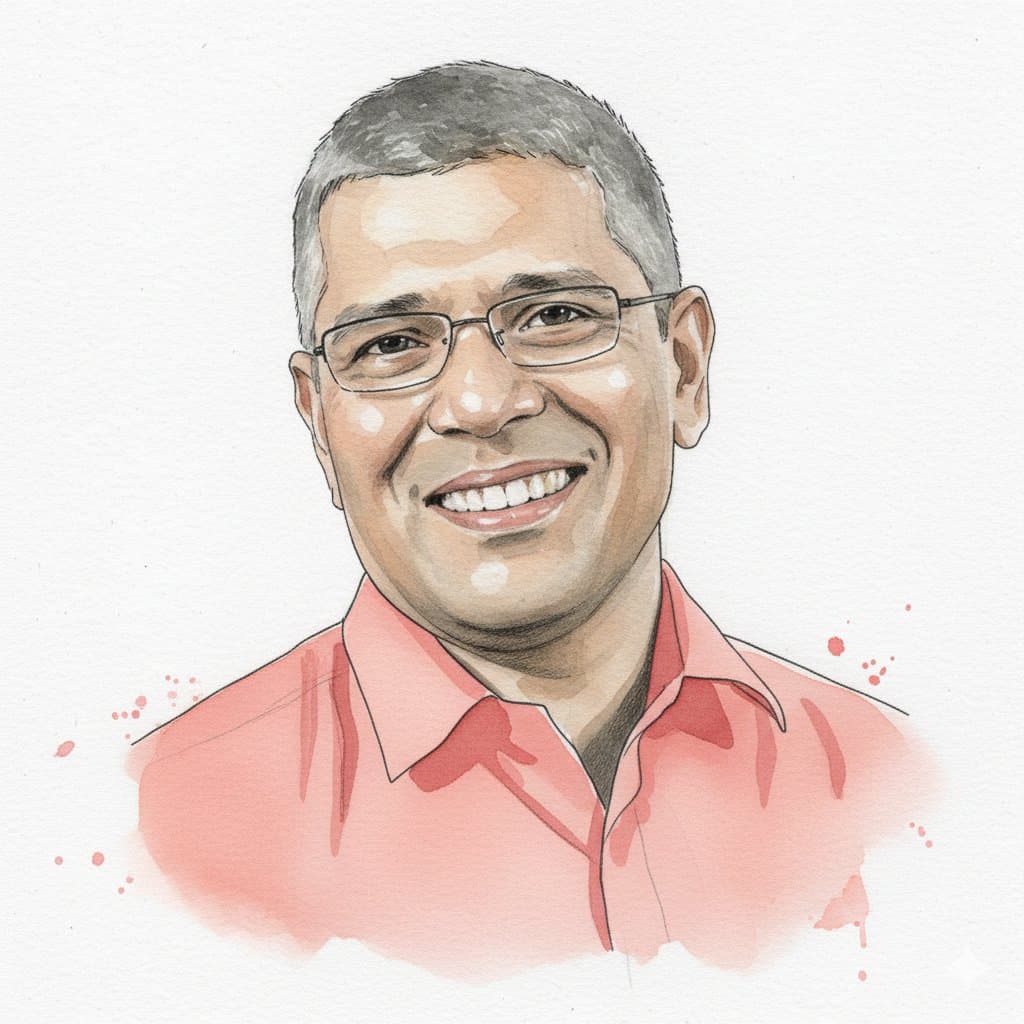
Premraj Menon
Founder, Simpleworks Consulting. 39 years across Telecom, Automotive and Consumer Durables — now helping Indian MSME and family-business founders grow with clarity.