How Do You Prepare a Second-Generation Leader to Take Over a Family Business? A Practical Succession Plan
This post argues that second-generation family business succession fails not from a lack of competence, but because founders treat it as a single handover event instead of a staged system that transfers earned authority and documents legal ownership together. It matters because a successor can run the business well and still lose it in a family dispute if the ownership question was never put on paper.
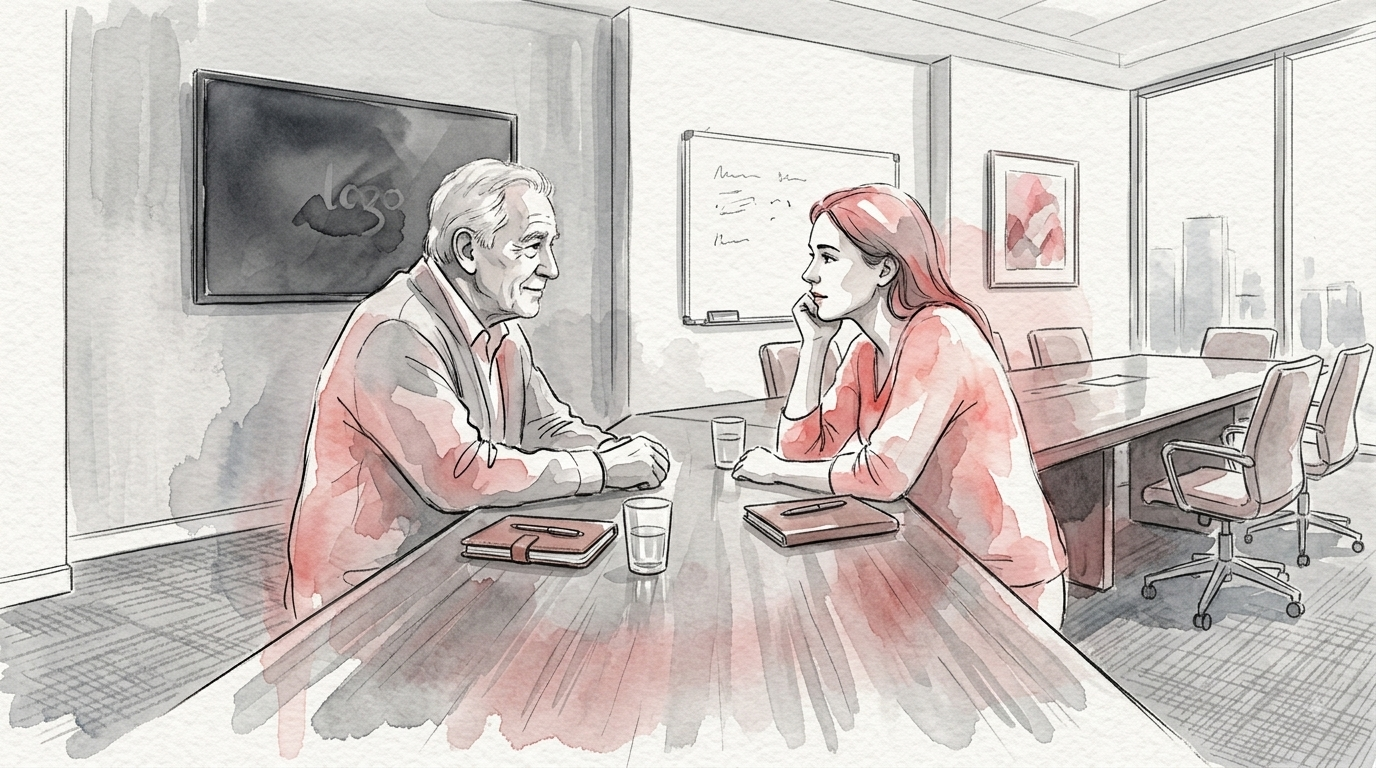
A founder announces his retirement at a family dinner. His daughter has been coming into the office for three years, sitting in on client calls, learning the ropes. Everyone assumes she's ready. What nobody has said out loud is that she's never made a decision above ₹5 lakh without her father's sign-off, and the shareholding papers still name him as sole owner. Family business succession planning consulting exists because of this gap: the difference between a successor who looks ready and one who is actually ready is not competence. It's whether authority and ownership were transferred as a system, over years, or announced as an event, over dinner.
Why Most Succession Plans Are Really Just Titles
Ask most Indian family business founders if they have a succession plan, and they'll point to an org chart with their son or daughter's name in the CEO box. That's not a succession plan. It's a title change.
A real plan separates three things that founders tend to treat as one- operating authority (who makes decisions day to day), legal ownership (who holds equity and on what terms), and reputational authority (whether employees, customers, and suppliers actually defer to the successor, or still walk past their office to the founder's). More than 80% of businesses in India are family owned or controlled, according to estimates from McKinsey and Deloitte. Yet by the Parampara Family Business Institute's count, just 13% of Indian family-run businesses survive to the third generation, and only 4% go beyond it — most often derailed by generational conflict, not market failure.
This matters because the three tracks fail independently. A successor can have full legal ownership and still have no operating authority, because the team still calls the founder for every decision. Or they can run the business well for years and still lose control of it, because nobody updated the shareholding structure before a family dispute forced the question. Preparing a second-generation leader means building all three tracks deliberately — not assuming that fixing one fixes the others.
Build Competence Before You Announce Succession
The single biggest mistake founders make is treating succession as a reveal. The successor "shadows" the founder for a year or two, gets introduced to key clients, and then one day gets the title. What they don't get is a track record of decisions with real consequences attached to their name.
Competence isn't built by observation. It's built by ownership of something bounded and real — a product line, a region, a customer segment — where the successor makes the calls and lives with the outcomes, good or bad, while the founder is still there as a safety net rather than the decision-maker. This is different from a "rotation" through departments, where the successor is present but never actually accountable. A successor who spent eighteen months owning the P&L of a single division, including a bad quarter they had to explain to the board, walks into the top job with a story the organisation already believes. One who spent eighteen months in meetings walks in with a title the organisation is still testing.
The timeline matters as much as the structure. Competence-building of this kind takes years, not months, which is exactly why it has to start long before the founder is ready to talk about leaving.
Who Gets What — The Legal Framework Succession Plans Skip
Here is where most succession conversations stop, because it's the hardest part to raise at a family dinner table, who legally owns the business once the founder is gone, and does that match who's running it.
Operating authority and legal ownership are separate transfers, and conflating them is where families get hurt. A shareholding structure drafted for a two-person founding generation rarely maps cleanly onto three children, only one of whom works in the business. Left undocumented, the assumption is usually that the operating successor will "naturally" end up with control — an assumption that has no legal weight and dissolves the moment a sibling contests it, or the founder passes without a will that reflects the business reality.
A workable legal framework, built while the founder is alive and able to make these decisions clearly, typically addresses four things: the equity split among all heirs, including those not active in the business; a will or family trust that has actually been updated to reflect current shareholding, not one drafted a decade earlier; a shareholders' agreement that separates voting rights from economic rights, so a non-participating sibling can hold economic value without controlling operating decisions; and an explicit, written answer to what happens to a non-participating heir's stake — bought out, held passively, or something else. None of this is optional once there's more than one heir. A successor can run the company brilliantly and still lose control of it in a family dispute if this framework was never put on paper.
This is legal and estate planning work, not something a business consultant should draft. But it is squarely a succession planning problem, because a family business succession advisor who ignores it is solving only half the transfer.
The Advisor's Role: Structuring What the Family Can't Design Alone
Founders are structurally bad at designing their own exit. They know the business too well to imagine it running without their specific judgment, and they're negotiating with their own child - a relationship with thirty years of dynamics that has nothing to do with org design. The successor, for their part, usually can't push back on a parent's timeline even when they should.
This is the real function of a family business succession consultant: not to make the decisions, but to structure the process so the family isn't negotiating authority and inheritance through unspoken assumptions and holiday-dinner tension. In practice, that means setting explicit milestones with dates attached, defining decision rights that shift on a schedule rather than a feeling, bringing in legal and estate counsel at the right points rather than leaving that work for "someday," and functioning as the person who can say a milestone was missed without it becoming a family argument.
None of this requires a large firm. It requires someone outside the family system who can hold both generations to a plan that neither one can hold themselves to, because they're too close to it.
The Next-Gen Succession Plan: Milestones That Transfer Power
Once competence-building is underway and the ownership question is on paper, the operating handover itself should follow a staged schedule — not a single date.
A workable next gen family business succession plan transfers specific decision rights in sequence: hiring and team structure first, since the cost of a bad call is recoverable; then capital allocation above a defined threshold, since this is where a wrong instinct does real damage; then customer and supplier relationships, which take the longest to earn regardless of title. Each stage has a fixed checkpoint — not "when it feels right," but a date on a calendar, reviewed against specific outcomes. And the founder retains an explicit, shrinking set of reserve powers over the transition period, a veto on decisions above a certain size in year one, gone entirely by year three.
Writing this down does two things a verbal understanding never achieves. It gives the successor a real deadline to build toward, and it gives the founder a structure that makes stepping back feel like a plan instead of a loss.
Where Staged Succession Doesn't Apply
The obvious objection: some founders hand over control in one clean transition, and it works. Staged plans, the argument goes, just prolong the uncertainty of a slow handover instead of resolving it.
This is true, but only under a specific condition. The founders for whom an overnight handover works almost always had a successor who'd already built credibility somewhere the family couldn't grant it - running their own venture, leading a major function at another company, or otherwise proving judgment under real consequences, just not inside the family firm. In those cases, the "staging" already happened; it just happened externally. The exception doesn't disprove the need for earned authority. It confirms it -the authority was earned, just not on the family's clock or inside the family's building.
For the far more common case, where the successor's entire track record sits inside the family business under the founder's supervision, skipping the staged transfer doesn't skip the need for credibility. It just means the organisation builds that credibility for the successor after the handover, in real time, with real risk attached - which is a more expensive way to do the same thing.
What You're Actually Building
The question founders ask is usually "is my successor ready?" It's the wrong question, because readiness isn't a fixed state you can test for on a given day. The better question is whether you're building your successor's authority, deliberately, on a timeline — or whether you're just building their title and hoping the authority follows.
The same discipline applies to the paperwork. A founder who has spent three years building their child's operating credibility, but never updated the shareholding agreement, has done half the job. The businesses that make it into the third generation tend to be the ones where both tracks -earned authority and documented ownership -were treated as work to be done now, not conversations to be had eventually. If you're a founder thinking about this, the honest test isn't whether your successor could run the business tomorrow. It's whether you've written down what happens if you don't wake up tomorrow. If you haven't, that's where to start -not with the announcement, with the plan behind it. You can read more of this thinking on the Simpleworks Consulting blog, or see how Simpleworks Consulting approaches this kind of engagement
About Premraj Menon
Premraj Menon is the founder of Simpleworks Consulting, working with MSME founders and growth-stage businesses across India to turn strategy into execution. With experience spanning manufacturing, SaaS, retail, and professional services, Premraj brings a practitioner's eye to the problems most consultants only theorise about.
Thinking through your own succession plan?
Let's have a quick introductory call with Premraj Menon →
Premraj Menon
Founder, Simpleworks Consulting. 39 years across Telecom, Automotive and Consumer Durables — now helping Indian MSME and family-business founders grow with clarity.