How Aarav Chose a Cofounder, Friend or Skill-Fit?
Aarav had built the product but had no one who could sell it. Part 1 of the Loopwise AI story follows his choice between a skilled stranger and his college roommate, and the frameworks that made the call clearer

Where Aarav comes from
Aarav grew up in Meerut, in a house where the plan was never discussed because it didn’t need to be. Get into a good engineering college. Get a stable job. Be the one who made it out. He did the first part. Delhi Technological University gave him a seat in BTech computer science, and the hostel gave him a roommate named Kabir. Within a semester they were past being strangers. Aarav was the one who stayed up rewriting a project that already worked. Kabir was the one who talked the professor into a deadline extension, and then talked the canteen into extending their tab. The difference between them showed early. Aarav could build almost anything he could describe. Kabir could get almost anyone to listen to the description. Neither saw this as a business asset. It was just how the friendship ran. The stable job lasted a while. Then, like a lot of engineers from smaller cities, Aarav came to Bengaluru with a laptop, a rented room and a stubborn belief that he was meant to build something of his own. The city has thousands of people with that belief. Far fewer have thought about who they will need standing next to them.
The problem
He had the product. Months of late nights had produced an AI tool that read supplier contracts and flagged risky clauses, and it worked. Three pilot users, all people he knew, said they would pay.
What he didn’t have was anyone who could sell it to a company that had never heard of him. He knew roughly what that job involved, enterprise buyers, procurement cycles that run for months, a legal team that says “send it to security” and then goes silent for six weeks. He had done none of it.
Two people were on the table. One was a former colleague, outside his friend circle, with a real enterprise sales record and a professional way of discussing equity. The other was Kabir, now in Bengaluru too, whose biggest sale so far was a fest sponsorship. Kabir was also the man who had driven across the city at 2 a.m. when Aarav’s father was in hospital. Aarav’s gut said Kabir. His spreadsheet said the colleague. He took both to Arjun Rao, an angel investor he had met at a Bengaluru meetup.
Arjun listened and asked one question. “Which mistake can you afford to discover in month eight?” Then he told Aarav to put the spreadsheet away. “You’re comparing two people. You should be comparing two risks. Come back with a pen.”
Two risks
Over a long chai at a Koramangala café, Arjun laid it out. Trust protects you from conflict, the blow-up over equity, credit or a bad quarter. Skill-fit protects you from slow execution, the twelve months spent learning what a specialist already knows. Founders tend to optimise the one that burned them last time. Stung by a bad hire, they pick the friend. Stung by a bad friendship, they pick the stranger. The two risks don’t age the same way. Skill can be seen. If Kabir can’t run a discovery call today, everyone will know by Friday, and a hundred bad calls will fix most of it. Trust stays invisible until something tests it, and what tests it is cash running short or a pilot churning, which lands on the business and the friendship in the same week. A partnership can survive a missed target. It rarely survives one partner feeling the other hid something. Arjun added a fact Aarav hadn’t expected. Noam Wasserman, a Harvard Business School professor who studied about ten thousand founders for his book The Founder’s Dilemmas, found that teams formed among friends and relatives are the least stable of all. His explanation, you assume you don’t need to talk, and you hold back doubts because you fear they could damage a relationship you value. “So the friend isn’t the safe choice,” Arjun said. “And the stranger isn’t either. The question is which gap closes and which one cracks.”
First, do you need a cofounder at all?
Arjun’s first exercise was blunt. On a napkin, Aarav wrote what the company had to get done in its first eighteen months, build the product, sell it, run the day to day, fund the next stage. Then a name against each.
Aarav’s name went against build, obviously. It also went against run, because nobody else was there, and against fund, because he was the one who would be doing the investor calls. Next to sell there was nothing. “That’s your gap,” Arjun said. “You don’t need a cofounder in general. You need one for a single job, and it’s the one that stays core for years. If this person left in month eighteen, would you be in serious trouble or just inconvenienced? If it’s only an inconvenience, hire or contract. Equity is for the first answer.”
The same napkin showed a second risk. If Aarav picked someone who also wanted to build, they would be two engineers avoiding the phone.
The Trust vs. Skill map
Under the job list, Arjun drew a two-by-two. Trust on one axis, do I know how this person behaves when things go wrong? Skill-fit on the other, can they do the specific job this company needs, now?
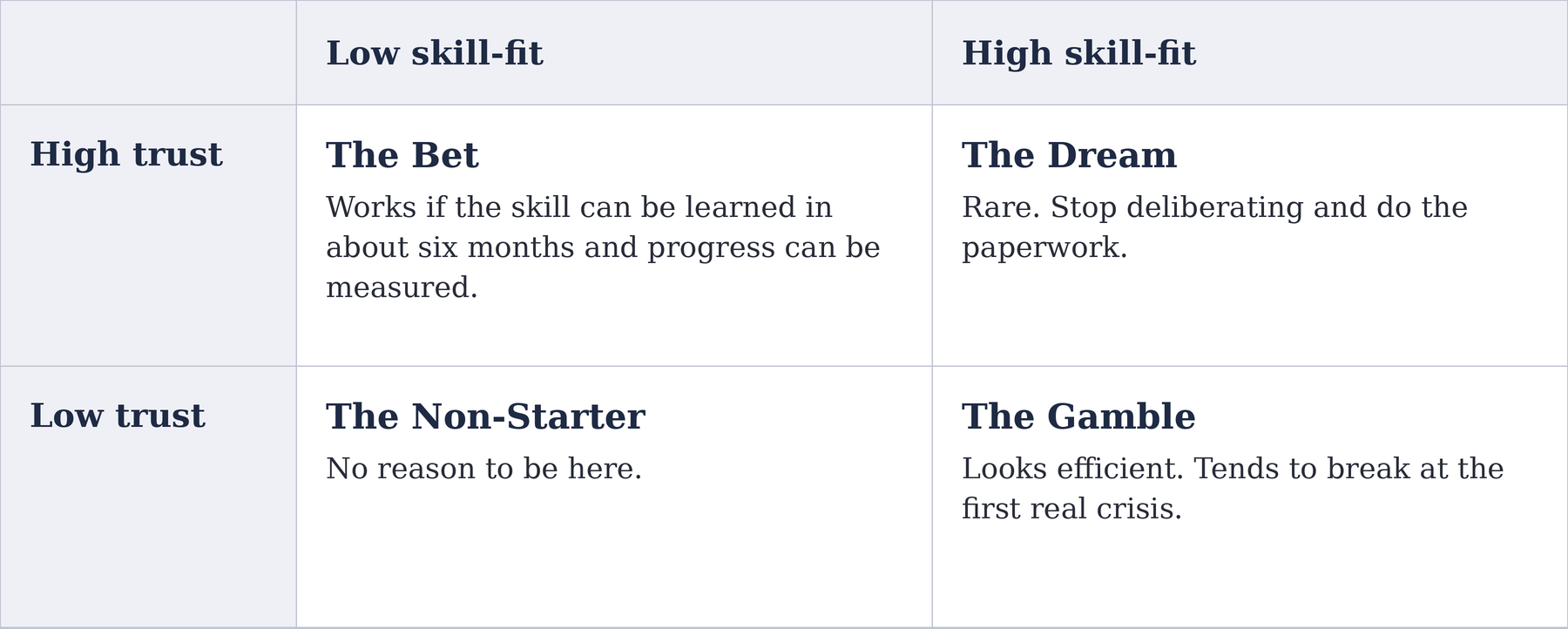
Aarav placed the colleague in the Gamble, high skill, no history. “That quadrant catches smart people,” Arjun said. “A strong resume feels like a risk-free choice. But untested trust has to survive its first bad month on goodwill nobody has had time to earn.” Kabir sat in the Bet, high trust, low skill. The Bet is often safer than it looks, but only if you treat it as a bet with a deadline and a way to measure progress. What you are wagering on is how fast one person can learn. Arjun then gave him three tests for whether a skill gap can close.
- Skill or temperament? Running a discovery call, writing a proposal and handling procurement can be learned. Comfort with rejection, and the willingness to pick up the phone again after a bad call, mostly can’t, and they show up in weeks. Aarav thought of the canteen tab, and of Kabir asking a professor for the third extension in a row, completely unembarrassed. That was a good sign.
- Can it be observed weekly? If you can’t tell within a month whether the person is improving, you can’t manage the bet.
- Can someone close it faster? A mentor or an honest customer
Five conversations before any equity
Skill shows on a resume. Alignment doesn’t. Arjun told Aarav to have five specific conversations with Kabir, one at a time, over several sittings, before a single number about equity was said aloud.
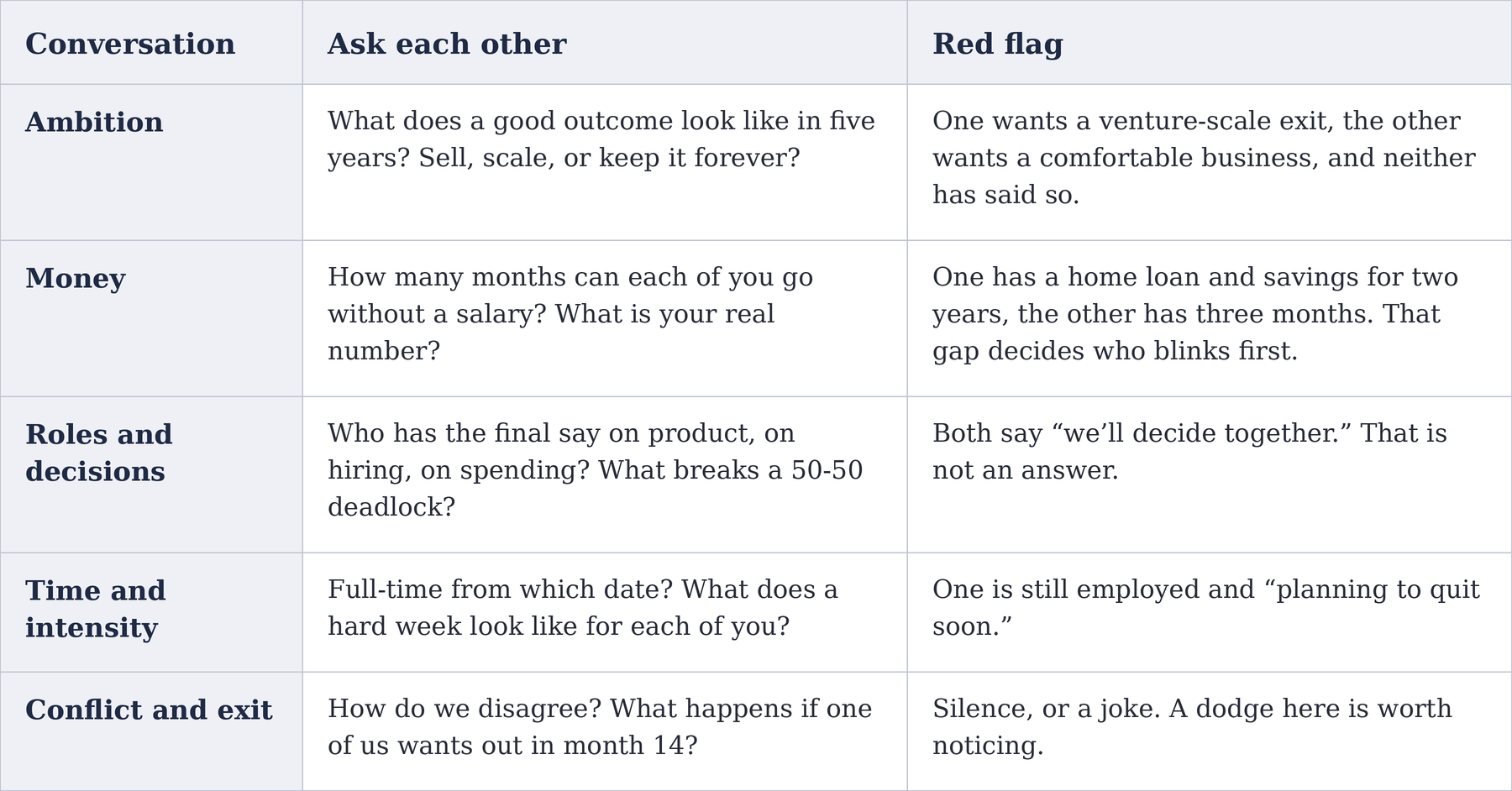
Aarav and Kabir spread them over a week. Most went smoothly, and that was almost the problem. When they reached money, it turned out Aarav had savings to last about eight months, and Kabir about three. Nobody had ever said so. Kabir had been quietly assuming he could cover the gap by taking up occasional freelance work, and Aarav had been quietly assuming that was fine. When they said it out loud, it changed the plan, a smaller early salary, a clear runway date, and a day on which they would decide whether to raise or keep going. The last conversation was the hardest. Asked what would happen if one of them wanted out in month fourteen, they both made a joke. Then Kabir stopped laughing and said, “No, I actually want to know.” That was the moment the exit terms started to get written
The 90-day trial
Arjun’s last rule, never decide on conversations alone. Decide on evidence. So Aarav picked Kabir, but not the way people usually pick a friend. Over two evenings the two of them wrote a 90-day trial cofounder agreement. It was not a legal document. It was one page with dates on it. Kabir’s first reaction was a joke about being put on probation by his own roommate. His second was to ask for the milestones in writing.
• Days 1 to 30, thirty conversations with target buyers, recorded and reviewed together. The aim was to learn what buyers actually say, not to sell. • Days 31 to 60, five serious pilot conversations that reach a named decision-maker, each with a written summary. • Days 61 to 90, one paid pilot, or a written account of exactly why not. • Day 90, each scores the milestones separately, then they compare. Three outcomes were named in advance, continue as cofounders, continue with different roles, or part as friends with Kabir as an advisor.
Arjun also told Aarav to take references on Kabir the way he would on a senior hire, and to ask each referee one unglamorous question, tell me about a time Kabir disagreed with you, and what happened next. The answers were useful, and at least one of them was not flattering. Aarav told Kabir about it, and they put it into the day-30 review. It was not painless. Kabir went quiet for a day after the first evening, and Aarav spent it wondering whether he had just bruised the one friendship he couldn’t afford to bruise. For three months Kabir would be measured by his oldest friend, and Aarav would carry a gap he couldn’t fill himself. If Kabir missed the milestones, the company would have lost a quarter, and nothing in the agreement gives that time back.
The page did something subtler than reduce business risk. It separated the friendship from the decision. If Kabir missed the milestones, the conversation on day 90 would be about milestones, not about whether Aarav had lost faith in him. Kabir could fail at the job without failing at the friendship, because both of them had defined the job in advance, in daylight.
Structuring the deal
Arjun made three more points about the paperwork, and he was firm about them.
Vesting for both of them. The common structure is four years with a one-year cliff, nothing vests if someone leaves in the first year, a quarter vests at the cliff, and the rest vests gradually after that. Aarav was on it too. Vesting is what lets you be generous with equity, because a wrong early bet then costs a year, not a decade.
Split on the future, not the past. Michael Seibel of Y Combinator argues that a great company takes years to build, so small differences in year one don’t justify large differences in ownership across years two to ten. He usually recommends equal splits among cofounders. Wasserman found that 73% of the founding teams in his data set split equity within the first month, most of them in a way that left no room to adjust. His advice is to match uncertainty with flexibility, think through the scenarios that could change the team and write down how equity would shift under each. Aarav and Kabir agreed to settle the split itself in a separate, deliberate conversation after the trial. That conversation is the subject of the next part of this series.
Decision rights and exits in writing. Aarav would have the final say on product, Kabir on commercial matters, and anything shared would wait 48 hours and then go to Aarav as CEO. They also wrote down what each kept if someone left. Arjun told them to have a lawyer turn it into a proper founders’ agreement before incorporation, not after.
When Arjun saw the one-page trial agreement, he said, “Most founders write the exit terms when they are angry. You wrote them while you still like each other.”
The pitfalls Arjun kept pointing at
Arjun kept returning to the same few mistakes. Aarav copied them onto the back of the napkin.
- Choosing on one axis only. The friend by default is the commonest route and, in Wasserman’s data, the least stable. The resume by default leaves you with a stranger and no stored trust when the first crisis arrives.
- The clone. Two people with the same strengths feel in sync and leave the same gaps open.
- The rushed split. Equity fixed in the first month, with no vesting and no way to adjust.
- Unspoken ambition and unequal commitment. One founder is building to sell in four years, the other to run for thirty. Or one is all in while the other keeps the day job “for now”. Neither shows until the first offer or the first hard month, when it is too late to be polite about it.
- No decision rights. Everything is joint until the day it can’t be.
- Avoiding the hard talk. The warmer the friendship, the harder it is to say “I think you are underperforming.” Put a regular feedback conversation on the calendar, so nobody has to find the courage on a bad day.
The same map, a different business
None of this belongs only to startups. Picture a ₹30 crore manufacturer, three years into a growth push, who needs a head of sales. One candidate is his brother-in-law, who has run a small trading business and will work every hour there is. The other is a professional from a larger company with a strong record and no history with the family. The people are different but the map is identical, the same two risks, the same question about which gap closes and which cracks, and the same case for a defined trial with written milestones instead of a handshake at a wedding.
Family businesses often skip the written part because it feels like an insult. In practice it protects the relationship, because the awkward conversation happens once, early, instead of repeatedly, late.
A checklist to take away
• We have worked on something real together, with friction in it. • I have spoken to at least two people who have worked with them, and asked about disagreement. • We have had all five conversations, and at least one answer was uncomfortable. • Each core job has a name against it. • Equity is vested for everyone, and the split can be defended on future contribution. • Decision rights and exit terms are written down and reviewed by a lawyer. • We have agreed a date on which we review how this is working.
The one thing to remember
Cofounder choice is not friend versus stranger. It is this.
Can the skill gap close faster than the trust gap can crack?
If the answer is yes, and you can show it with dates and milestones, pick the person you trust. If you can’t measure it, trust alone won’t save you. And if you go with the skilled stranger, build the trust on purpose, with checkpoints you both agreed to in advance.
A question to answer before you close this tab, if your cofounder left tomorrow, which of the five conversations would you wish you had had?
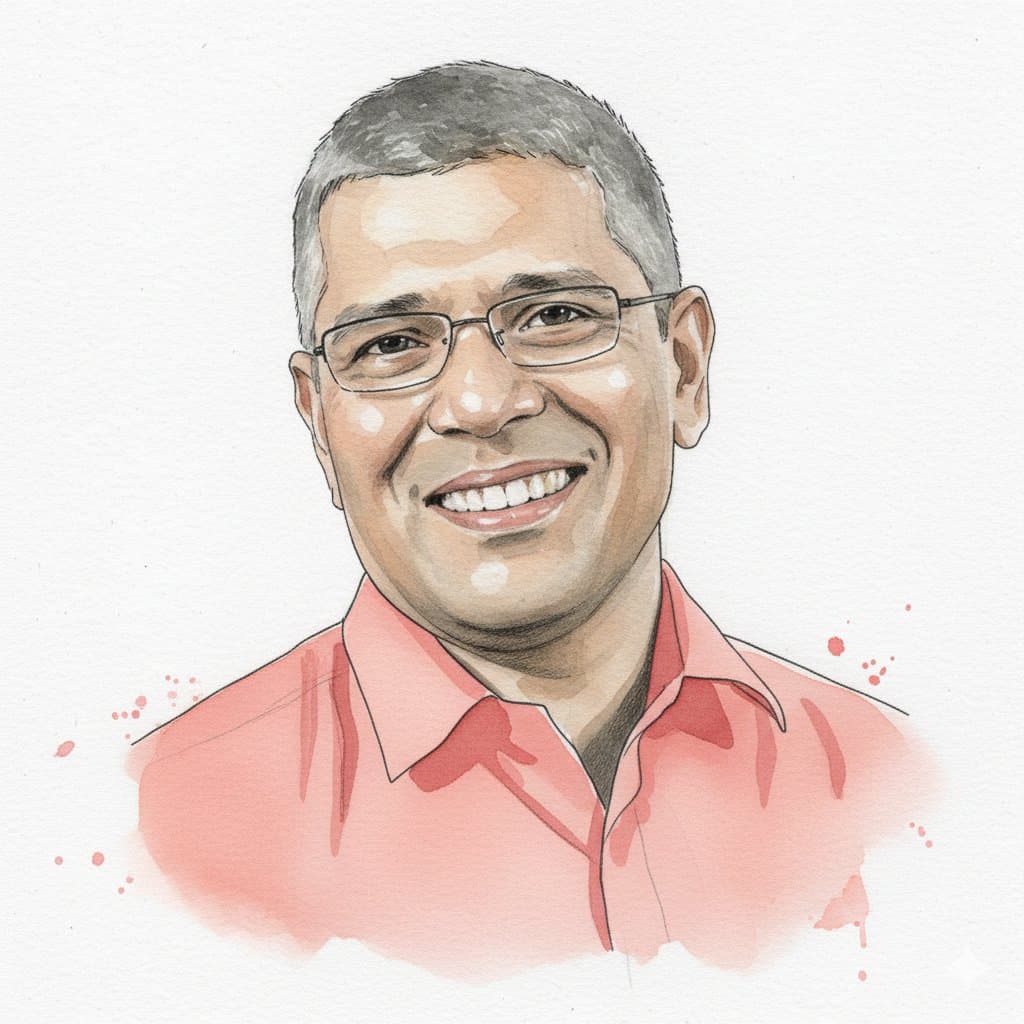
Premraj Menon
Founder, Simpleworks Consulting. 39 years across Telecom, Automotive and Consumer Durables — now helping Indian MSME and family-business founders grow with clarity.