Who Is Your Customer, Really?
A first principles guide for MSME entrepreneurs on finding, sharpening, and going to market with your Ideal Customer Profile.
A founder I follow posted something on LinkedIn recently that's stayed with me.
He described a series of conversations with a trusted advisor — conversations he called brutally honest — where every vague definition of who his company was selling to got systematically torn apart. After those conversations, after what he called "a truckload of internal reflections," his company hit ₹8 crore ARR in three months. He credited one thing above everything else: the sharpness of his ICP definition stating - The more sharply defined the ICP, the more sharply defined the problem statements, the more sharply defined the offerings.
Most people read a story like that and think: I should sharpen my ICP too.
The more interesting question is: why does sharpness work at all? What is actually happening when you go from a blurry definition of your customer to a precise one?
I think the answer sits deeper than marketing. It's about how you know, what you know.
The Wrong Question
Most founders treat an ICP as a description you write. You fill in some boxes — industry, company size, geography, role of the buyer — and now you have an ICP. Tick. Move on to execution.
This produces documents that sound specific but are still vague. "B2B companies with 10–200 employees in the tech sector" is not an ICP. It's a census category.
The problem starts with the question founders are asking.
The typical question: who could buy from us?
The question that leads somewhere: for whom are we the only sensible choice?
These feel similar. One of them has a much smaller answer — and that smaller answer is worth far more.
What Is a Customer, Actually?
A customer is someone with a problem, a budget, and enough urgency to act. All three need to be present. A problem with no budget is a conversation. A budget with no urgency is a pipeline item that will never close. Urgency with no real problem is a deal that will unravel after you deliver.
Now: what makes a customer ideal?
The common answer is that they pay well, renew, and refer others. But those are outcomes. The definition underneath them is: an ideal customer is one for whom you are the optimal solution to their most important problem.
Not a good solution. Not one of several reasonable options. The optimal one.
When you are the optimal solution, the commercial dynamics change completely. Price resistance drops because the alternative is worse. The sales cycle compresses because they're not shopping. Referrals happen naturally because the customer's peers have the same problem. The customer is invested in your success because their outcome depends on it.
When you're merely a decent solution, you spend your time competing. The customer knows there are alternatives roughly as good. You're on a spreadsheet. You're being compared. Every proposal becomes a negotiation.
The gap between decent and optimal isn't a quality gap. It's a fit gap. You can be excellent and still be in the wrong room.
Why Your ICP Is Probably Still Vague
There is a specific reason most MSMEs avoid sharpening their ICP. It is not laziness. It is not lack of frameworks. It is fear of exclusion.
If you define your ICP precisely, you are simultaneously defining who you are not for. And most founders, especially early on, are not ready to close doors.
What if we miss a segment? What if that adjacent category has buyers who would pay? What if we're leaving money on the table?
So they hedge. They write an ICP broad enough to cover almost any business in a vague sector. And then they wonder why their message isn't landing anywhere in particular.
When you speak to everyone, your message is average by construction. Try averaging the concerns of a ₹5 crore manufacturer, a ₹30 crore SaaS startup, and a ₹15 crore retail chain. The message you'd write is technically relevant to all three and compelling to none.
A message targeted at ten people who feel it precisely will outperform a message broadcast to a thousand people who find it mildly relevant. Not sometimes. Always. Because the ten who feel it will act on it, talk about it, and bring you more of themselves.
The ICP Is a Hypothesis, Not a Document
Stop treating your ICP as something you write. Treat it as something you test.
A scientist doesn't describe a theory and call it done — they try to break it. They look for the conditions under which it fails. They update the theory when evidence contradicts it. The theory gets sharper through falsification, not through better writing.
Your ICP works the same way.
Start with your best hypothesis: "I think our ideal customer is X, facing problem Y, at a moment in their business when Z is happening." Then go find out if you're right. Have real conversations. Look for confirmation — and more importantly, look for the cracks.
When you lose a deal, ask: was this not our ICP to begin with? Or was it our ICP but we failed to execute? Those two explanations demand completely different responses.
When you win unexpectedly, ask: what made this customer different? Is this a one-off or a signal pointing to a segment you hadn't seen?
Over weeks — not months, if you're having the right conversations — you converge on something true. Not something invented in a planning session. Something discovered.
How to Sharpen Your ICP: Four Rounds
What those brutal conversations that founder described were doing — stripping away comfortable generalisations until only defensible claims remained — is Socratic method applied to customer definition.
"We help growing businesses" becomes "what does growing mean exactly?" becomes "revenue growth, headcount growth, or market expansion?" becomes "which of those creates the most urgency in the buyer?" and eventually you arrive at a statement that holds up under scrutiny.
You can run this yourself, but it's harder alone. The mind is very good at filling in vague definitions without noticing. You need friction — someone who won't accept the comfortable answer.
Round 1: Describe Your Best Customer
Pick your single best customer. Not the highest revenue — the best in the fuller sense: profitable, easy to work with, values what you do, refers others, and represents work you're proud of.
Write a paragraph describing them. Be as specific as you can.
When you're done, read it back and ask of each claim: how would I know if this were false?
"They are a growing B2B company" — what counts as growing? What's the minimum growth rate? What if they're in a contracting market but taking share?
"They value strategic thinking" — how do you know they value it versus just saying they do? Did they pay for it? Did they implement what came out of it?
Keep asking until every adjective is load-bearing.
Round 2: Find the Trigger
A customer doesn't buy from you because they fit a profile. They buy because something happened.
Something changed in their world. A new competitive threat appeared. They missed their quarterly target for the second time. A key person left. The board asked a question they couldn't answer. They read something that named a problem they'd been struggling to articulate.
The trigger is the moment when staying with the status quo became more painful than changing. If you can identify it, you can find your ICP before they come looking for you — present at the moment of recognition rather than competing for attention six months later when everyone is pitching them.
Go back to your five best customers. Ask each of them: "What was happening in your business in the weeks before you decided to engage us?" Don't suggest answers. Let them tell you. You will hear the same two or three triggers repeated. Those are not data points. They are the thing.
Round 3: Define the Problem You Actually Solve
This is where most ICP work breaks down. Founders describe their offering — the methodology, the deliverables, the process — and treat it as the problem they solve.
What you do is not the problem you solve. What changes in the customer's world because of what you do — that is.
The question: what becomes true for the customer that wasn't true before?
Not "we delivered a GTM strategy." What became true? The founder could walk into a board meeting with a growth plan she could defend. The sales team stopped losing deals to "we'll think about it." They hired the right head of sales because the role was finally clear enough to describe.
The further you go from deliverable toward outcome, the closer you get to the problem the customer actually hired you to fix. Name that problem precisely and your ICP will recognise themselves in it immediately.
Round 4: Build Your Exclusion Profile
Most founders resist the exclusion profile. It feels like turning away revenue. But a customer who is not your ICP is not a neutral event. They are a cost.
They cost you time — in misaligned sales conversations and scope creep. They cost you energy — delivering work that doesn't sit in your strength. They cost you opportunity — hours on a bad-fit engagement are hours not spent finding the right ones. And they cost you learning — a bad-fit engagement teaches you nothing about your real market, because the feedback signal is noise.
Look honestly at your most difficult or least profitable customers. Not the most demanding in terms of behaviour — the worst in terms of fit. What do they share? Stage, sector, expectations, the price point they entered at?
Write the pattern down. Then make it explicit: these are the types of organisations we will say no to, even when they are willing to pay.
This feels counterintuitive. It is also what protects the quality of your pipeline and the clarity of your positioning as the business grows.
From ICP to GTM
A sharp ICP doesn't guarantee good execution. But it makes good execution possible, because every element of your GTM — your message, your channel, your first conversation, your proof — can now be built to fit one precise customer rather than averaged across many.
Your Message Is a Signal, Not a Tagline
Write a message so specific to your ICP that anyone outside it would find it irrelevant. That's the test. If your message is broadly appealing, it isn't doing its job.
The structure:
"We help [exact ICP] who are dealing with [named trigger situation] to achieve [specific outcome], without [the thing they've already tried that didn't work]."
"Dealing with" is more urgent than "interested in." Naming what didn't work acknowledges their experience and makes you credible. The outcome should be the thing from Round 3 — what becomes true, not what you deliver.
Test this in conversations before you publish it anywhere. You'll know it's right when someone stops mid-conversation and says: "That's exactly where we are."
Channel Follows the Trigger, Not Convenience
Most MSMEs choose marketing channels based on what they're comfortable with, what peers are doing, or what someone recommended. The right question is different: where does my ICP go in the 24 hours after the trigger fires?
Some founders call a peer. Some search at midnight. Some open LinkedIn. Some show up at one specific conference every year. Some respond to a WhatsApp from someone they respect.
Map the journey backwards from the trigger. If you can be present at that moment — with the right message, in the right form — you don't need a large marketing budget. You need to be in the right place.
For most B2B MSMEs in India, the highest-leverage channels are: your own network and their first-order connections, LinkedIn for whatever segment of your ICP is active there, and deliberate referral relationships with two or three professional adjacencies who serve the same customer without competing with you.
Before adding any channel, ask two questions: is my ICP actually there, and can I be consistent here for at least 90 days? An inconsistent presence is worse than no presence, because it signals that you're not serious.
The First Conversation Is a Fit Assessment, Not a Pitch
The purpose of the first meeting with a potential customer is not to sell. It is to find out whether this person is actually your ICP.
When you walk in trying to sell, you're listening for openings. When you walk in to assess fit, you're listening for truth. The customer feels the difference. The second posture builds more trust in 30 minutes than the first builds across three meetings.
The question you're trying to answer: do they have the problem, at the intensity, at the stage in their business, that your ICP definition says they should have? If yes, the conversation will move naturally toward an engagement. If no, you leave with clarity — which is valuable in a way that a wasted proposal never is.
Your opening should invite them to describe their situation without you directing the answer. "Tell me where things stand with [the problem area] right now" gives you truth. "Are you struggling with X?" gives you confirmation bias.
Proof That Matches the Profile
A case study from a ₹200 crore corporate says nothing useful to a ₹15 crore founder. A B2C testimonial doesn't reassure a B2B SaaS buyer. Proof that doesn't match the profile creates a quiet doubt: maybe this works for someone else, but I'm not sure it works for someone like me.
For every claim you make, the question is: does my ICP see themselves in this?
If you don't have matched proof yet, that is the first thing to create. One engagement, done well, documented carefully, converted into a specific case study, is worth more than ten generic recommendations. It is the reference against which all future sales conversations are anchored.
Closing Is a Confirmation, Not a Technique
When the ICP is right, the message is resonant, the proof matches, and the first conversation was honest — closing is not a challenge. It's a conclusion both parties have already reached.
You're not persuading someone. You're confirming what both of you already sense: real fit, real problem, achievable outcome.
The only question worth asking is: "Does this feel like the right fit to you?"
If they hesitate, that hesitation is information. Don't push past it. Ask: "What's making you uncertain?" The answer will either reveal a genuine misfit — in which case you've both saved time — or it will surface a specific concern that can be addressed.
Founders who have done the ICP work properly often describe the close as strangely undramatic. That's not luck. The work that made it easy happened weeks earlier, in the uncomfortable honesty about who they actually serve.
The 30-Day Sprint
Days 1–7: Look backward. Rank your top five customers on revenue, profitability, ease of relationship, referral value, and how proud you are of the work. Interview at least two of the top three. Ask one question: "What was happening in your business when you decided to engage us?"
Days 8–14: Find the pattern. Write down what your top customers share — not the obvious categories, but the situation, the trigger, the real problem. Write your ICP hypothesis. Then try to break it. Where doesn't it fit? Where are you stretching the definition? Cut those parts.
Days 15–21: Test the message. Write your message using the structure above. Have five conversations with people who might fit your ICP. Watch the reaction when you describe the kind of customer you work with. Are they leaning in? Are they saying "that's us"? If not, either the message or the hypothesis needs revision.
Days 22–30: Go to market with it. Identify ten organisations that match your tested ICP. Map the relevant decision-maker inside each. Plan outreach as a series of genuine conversations, not a sales sequence. The ICP is never finished — it gets more precise with every conversation you have.
The Deeper Point
The founder's story that opened this piece is memorable because of the numbers — ₹8 crore ARR in three months. But the more important part is what he said about the process: brutal honesty, repeated challenge, the willingness to have comfortable generalisations torn apart until only defensible claims remained.
Most of the friction in building a business comes from operating on beliefs that feel true but haven't been tested. "We can serve anyone in this space" feels like ambition. It's a belief that's never been examined.
The ICP exercise, done seriously, forces that examination. It draws a hard line between what you actually know — from evidence, from real conversations, from deals won and lost — and what you've assumed because it was convenient.
That line, drawn honestly, is what makes the problem statement sharp. The problem statement is what makes the offering sharp. The offering is what makes the sales conversation short.
Not because you've written a better description. Because you've finally stopped guessing.
Premraj Menon is the founder of Simpleworks Consulting, a boutique management consulting firm based in Bengaluru helping Indian MSME entrepreneurs and startups grow with clarity and confidence with simple interventions .If you think you need help solving a business problem do write to him at pm@simpleworks.in for a conversation over coffee. Cheers
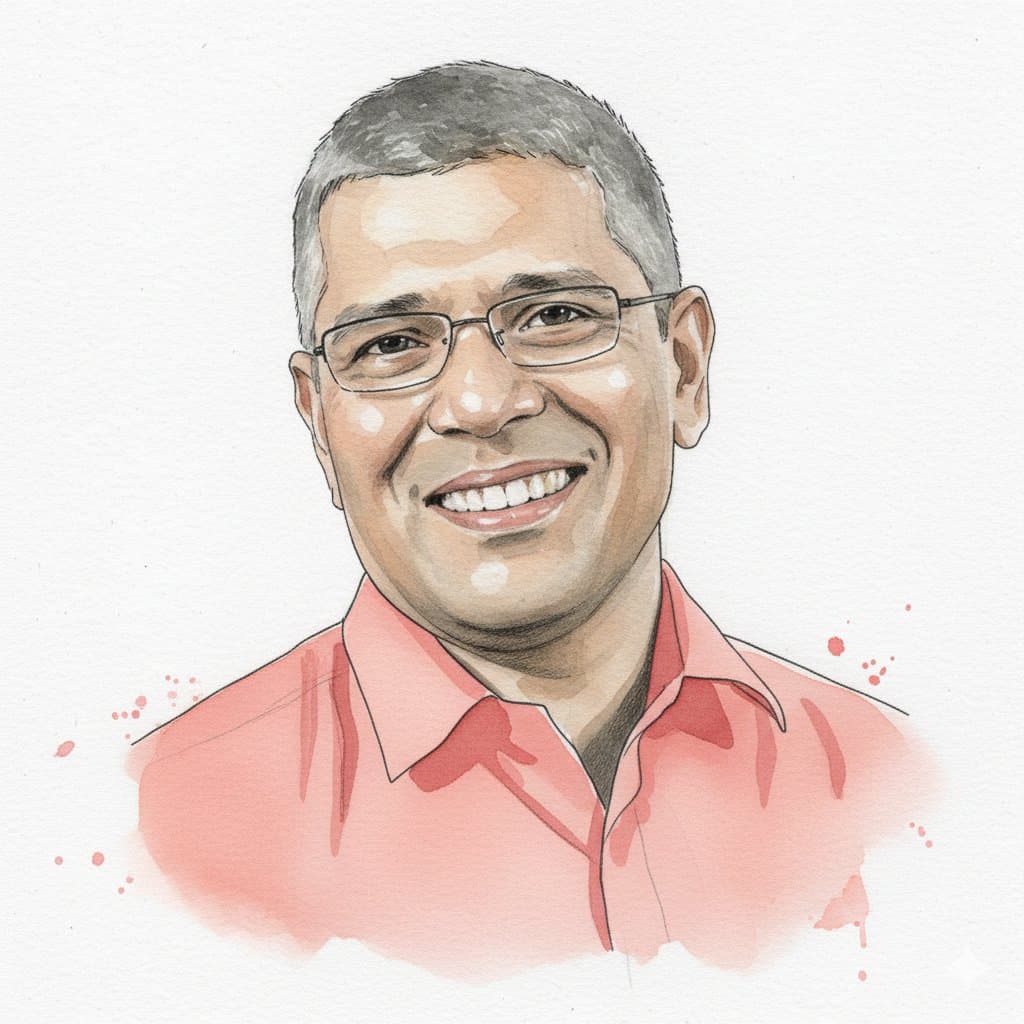
Premraj Menon
Founder, Simpleworks Consulting. 39 years across Telecom, Automotive and Consumer Durables — now helping Indian MSME and family-business founders grow with clarity.